
Paul Müller Safety Emergency Trolley


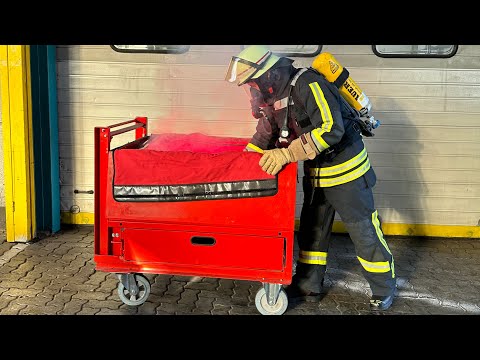
- Internal dimensions of the tub: 778 x 1109 x 420 mm
- Internal dimensions of drawer: 788 x 955 x 185 mm
- External dimensions: 1200 x 800 x 983 mm
- Includes fire-retardant agent and fire-retardant bag
Do you have some questions about this product?
- Your personal contact person
- Name: Petra Fürbeck
- E-Mail: info@lion-care.com
- Phone: +49 (0) 7151 - 256 4817
Technical data
| Filling material: | Extover extinguishing granules, Fire protection bag |
|---|---|
| Handling of filling materials: | Fire protection bag, bulk material |
| Included filler material: | Expanded glass granulate (bulk material) |
| Internal dimensions (mm): | Bath: 1 109 x 778 x 420, Drawer: 788 x 955 x 185 |
| Material: | Steel |
| Material designation: | Stainless steel |
| Outer dimensions (mm): | 1 200 x 800 x 983 |
| Packaging type: | Recovery systems |
| Tipping weight (kg): | approximately 295 |
| Type: | Recovery system |
| Volume (l): | 940 |
| Volume (l): | > 600 |
Product information „Paul Müller Safety Emergency Trolley“
Lithium batteries are not only used in electric cars manufactured by OEMs, but also in electric-powered industrial trucks, which are becoming increasingly common in in-house logistics. Lithium-ion batteries have also become indispensable in all other applications.
MÜLLER HAVARIE ROLLCONRAINER – Immediate hazard containment for lithium batteries showing signs of damage.
In the event of compromised batteries, the emergency container serves as a tool that can be deployed immediately at the scene. Thanks to its easily accessible front and dome hatches, the damaged battery can be quickly loaded into the container. The sealed container ensures a controlled reaction of the energy storage device. This system is a compact solution and is suitable for almost all locations. Examples include care homes, hospitals, administrative buildings and industrial sites. The wheeled containers can be easily integrated into existing logistics systems and blend seamlessly into the existing infrastructure, not least thanks to their design in accordance with AGBF recommendations.
Technical specifications and dimensions
The container is 1,200 mm long, 800 mm wide and 983 mm high. The width of the tray inside the container is 778 mm, the length is 1,109 mm and the height is 420 mm. The drawer is 788 mm long, 955 mm wide and 185 mm high. The recommended maximum energy density is 11 kWh.
Functions and features
The emergency container is designed for repeated use and is suitable for both dry and wet quarantine conditions. Damaged battery modules can be monitored inside the container without it necessarily having to be filled with water. Two dome hatches fitted to the top of the container can be opened out to the sides. Once loaded, the hatches are closed and the trolley containing the damaged goods can be wheeled out into the open in a short distance. A pressure relief valve fitted into the dome hatch ensures that no excess pressure builds up inside the container and that the pressure is released in a controlled manner. If the situation permits, the battery can be packed into the integrated fire-resistant bag beforehand.
Includes a Storz-D water connection for flooding the container
The container can be filled with extinguishing water via integrated filling devices until the battery is completely covered. The water can subsequently be drained via a ball valve fitted close to the floor. If necessary, contaminated water can be specifically drained via a drain and disposed of appropriately.
Includes 6 bags of Exotver dry extinguishing agent made from expanded glass granules
In addition, the container can be filled with 6 Exotver fire extinguishing agent bags, each holding 55 litres. Exotver is a specialised fire extinguishing agent made from expanded glass, which is non-combustible. The product is reusable and recyclable, thereby promoting longer-term use and the return of materials to the recycling cycle. The extinguishing agent displaces oxygen and thus helps to smother the fire, whilst also binding gases and vapours, which enables environmentally friendly disposal.
A specially manufactured fire safety bag provides additional security and is included with the set
Furthermore, there is an Akkusafe-type fire-resistant bag, which is specially manufactured for the container. The body of the bag is made from Bagtex, a special material which releases moisture inwards when heat is generated, thereby providing additional cooling. Part of the bag’s body is made from Flotrex (glass-fibre-reinforced aramid fabric reinforced with stainless steel and lined with fire-retardant fabric). This material acts as an expansion window, allowing the bag to vent in the event of an emergency.
Safe management of emergencies involving emergency containers. Rapid separation of damaged or reactive batteries
Paul Müller Safety’s damaged container systems were originally developed for use on production lines in the automotive industry. There, they have proven their worth over many years with various manufacturers. With the rise of electric mobility and the use of high-performance lithium batteries across various sectors, these emergency containers have now also become established in logistics centres, warehouses, shipyards, commercial vehicle workshops, bus depots and hospitals.
Tailor-made solutions for every sector
The container is suitable for use across a wide range of sectors and applications, which we would like to outline below:
Industrial companies
Havariecontainers have proven their worth on the production lines of car manufacturers for many years. This product was developed in direct response to demand from the automotive sector and is based on experience gained with hazardous goods load carriers already in use for the safe transport of lithium batteries.
Logistics centres, freight terminals and warehouses
Parcels, palletised goods and stock items increasingly contain lithium energy storage devices. During storage, transhipment or order picking, accidents and incidents involving lithium batteries occur time and again in day-to-day operations. This emergency container is installed as a fixed unit in logistics centres, high-bay warehouses and freight terminals.
Workshops for buses and commercial vehicles / vehicle depots
Electric and hybrid buses, fully electric lorries and electric vehicle fleets are regularly serviced and maintained in garages, bus depots and at vehicle manufacturers’ premises. The large-capacity emergency containers are often used for purposes other than their intended one and serve as temporary storage for removed battery packs.
Shipbuilding
Yachts, car ferries, excursion boats, cargo ships and cruise ships are increasingly being fitted with large-capacity lithium battery storage units for auxiliary propulsion or even as a primary energy source. During initial fitting and subsequent maintenance work at the shipyard, batteries are installed, removed, transported and serviced.
Certified quality from Germany
The containers are developed, manufactured and tested entirely in Germany and meet the highest quality standards.
Fire and drop tests to ensure the optimal solution
The container’s resilience and durability stem from the selection of the right materials and components. New developments are tested in fire and drop tests to assess their suitability for practical use. An in-house fire test facility enables testing in accordance with BAM specifications. A consistently implemented quality management system ensures consistent processes. Paul Müller GmbH holds certifications in accordance with DIN EN 14001, DIN EN 9001, IBE-BVI, EN 1090-1 in conjunction with EN 1090-2 EXC 3 and TISAX approvals. Both standard products and bespoke items undergo a visual inspection, a functional test and a leak test prior to dispatch.
PAUL MÜLLER SAFETY – Specialised solutions for demanding requirements
Paul Müller Safety stands for bespoke solutions designed specifically for challenging tasks. The company offers a wide range of products tailored to the needs of fire services, recovery companies and civil protection organisations.
The requirements for handling electric vehicles and battery storage systems are becoming increasingly complex and varied. Paul Müller Safety is a leading specialist in the safe transport and storage of damaged electric vehicles and large batteries. Paul Müller Safety’s products play a crucial role in managing large-scale transport operations and ensuring efficient logistics in day-to-day emergency response.
The company has developed specially adapted products for both fire services and civil protection that meet the requirements of these operational areas. Products have also been developed to meet the specific needs of towing and recovery companies. Paul Müller Safety’s many years of experience and extensive expertise enable it to offer innovative solutions that meet the highest standards of safety and efficiency.
Future-oriented
Lithium-ion batteries will become indispensable in all industrial applications in the coming years. However, if used improperly, these batteries can pose a significant potential hazard during manufacture, storage and transport. By purchasing these boxes, you protect yourself against major financial losses right from the start. International customers, including those in the automotive and energy supply sectors, place their trust in this proven technology.
Working for you
Please do not hesitate to contact us if you have any queries. We look forward to hearing from you.
| Filling material: | Extover extinguishing granules, Fire protection bag |
|---|---|
| Handling of filling materials: | Fire protection bag, bulk material |
| Included filler material: | Expanded glass granulate (bulk material) |
| Internal dimensions (mm): | Bath: 1 109 x 778 x 420, Drawer: 788 x 955 x 185 |
| Material: | Steel |
| Material designation: | Stainless steel |
| Outer dimensions (mm): | 1 200 x 800 x 983 |
| Packaging type: | Recovery systems |
| Tipping weight (kg): | approximately 295 |
| Type: | Recovery system |
| Volume (l): | 940 |
| Volume (l): | > 600 |
Downloads
FAQ
That depends on various factors that need to be considered:
- size of the battery(ies)
- condition (e.g. non-critical, defective, critically defective or prototype)
- power
Transport boxes are available in many different sizes and specifications. The packaging group for which the box is suitable is indicated for each product.
Find out more in our blog article:
https://www.lion-care.com/aktuelles/blog/transportvorschriften-regeln-und-sicherheitsmassnahmen
Even if the batteries are not critical, remember to protect them from shocks and to order appropriate filling material if it is not already included in the box.
Yes. Should a battery reach a critical state and cause a fire, separating the batteries will prevent the fire from spreading and multiplying.
Generally, the insulation and protection material should line all sides of the container. The batteries are stored between individual layers.
We also have containers in our program that already have the protective material integrated into the outer wall. No further protective layer is necessary here.
The technical principles for storage and transportation solutions are very similar. The transport boxes are also subjected to extensive tests in accordance with ADR (drop test, fire test, etc.) to confirm compliance with the ADR regulations. The packaging regulations are extensive and regulated by law.
There are currently no comparable regulations for storage. Nevertheless, manufacturers of storage boxes regularly carry out appropriate tests.
The right container depends on the type and size of the battery to be shipped or stored.
If you want to learn more about battery storage and transportation, you will find the answers in our blog articles:
https://www.lion-care.com/aktuelles/blog/transportvorschriften-regeln-und-sicherheitsmassnahmen
https://www.lion-care.com/aktuelles/blog/lithium-ionen-akkus-sicherer-umgang-und-richtige-lagerung
The transportation of batteries is subject to ADR regulations.
The number, size and weight, energy density and condition of the batteries are crucial parameters for finding a suitable transport container for lithium-ion batteries. The selection process is complex and should be carried out by appropriately trained personnel. We have a trained hazardous materials officer on our team. Please feel free to contact us.
Plastic containers are cheaper but not as durable as metal containers. They are suitable, for example, for non-critical batteries, defective batteries, prototypes and end-of-life batteries. They can be used for both storage and transportation.
Metal containers are required, for example, when dealing with critically defective batteries.
The exact packaging instructions for these cases can be found in the ADR or by consulting a certified hazardous materials specialist.
To date, there are no legal requirements for the storage of lithium-ion batteries, which does not mean that they should be stored without suitable protective measures.
It is best to check with your insurer to find out which measures they recognize as suitable in the event of a claim.
For example, a suitable box could already be recognized as spatial separation.
A rough overview can be found in this VDS publication from the GDV:
https://shop. vds.de/download/vds-3103/ccb1d439-ad9d-47cb-a2b1-ace23e155610
Please also read our blog article on this topic:
https://www.lion-care.com/aktuelles/blog/lithium-ionen-akkus-sicherer-umgang-und-richtige-lagerung
That depends on various factors that need to be considered:
- size of the battery(ies)
- condition (e.g. non-critical, defective, critically defective or prototype)
- power
Transport boxes are available in many different sizes and specifications. The packaging group for which the box is suitable is indicated for each product.
Find out more in our blog article:
https://www.lion-care.com/aktuelles/blog/transportvorschriften-regeln-und-sicherheitsmassnahmen
Even if the batteries are not critical, remember to protect them from shocks and to order appropriate filling material if it is not already included in the box.
Yes. Should a battery reach a critical state and cause a fire, separating the batteries will prevent the fire from spreading and multiplying.
Generally, the insulation and protection material should line all sides of the container. The batteries are stored between individual layers.
We also have containers in our program that already have the protective material integrated into the outer wall. No further protective layer is necessary here.
The technical principles for storage and transportation solutions are very similar. The transport boxes are also subjected to extensive tests in accordance with ADR (drop test, fire test, etc.) to confirm compliance with the ADR regulations. The packaging regulations are extensive and regulated by law.
There are currently no comparable regulations for storage. Nevertheless, manufacturers of storage boxes regularly carry out appropriate tests.
The right container depends on the type and size of the battery to be shipped or stored.
If you want to learn more about battery storage and transportation, you will find the answers in our blog articles:
https://www.lion-care.com/aktuelles/blog/transportvorschriften-regeln-und-sicherheitsmassnahmen
https://www.lion-care.com/aktuelles/blog/lithium-ionen-akkus-sicherer-umgang-und-richtige-lagerung
The transportation of batteries is subject to ADR regulations.
The number, size and weight, energy density and condition of the batteries are crucial parameters for finding a suitable transport container for lithium-ion batteries. The selection process is complex and should be carried out by appropriately trained personnel. We have a trained hazardous materials officer on our team. Please feel free to contact us.
Plastic containers are cheaper but not as durable as metal containers. They are suitable, for example, for non-critical batteries, defective batteries, prototypes and end-of-life batteries. They can be used for both storage and transportation.
Metal containers are required, for example, when dealing with critically defective batteries.
The exact packaging instructions for these cases can be found in the ADR or by consulting a certified hazardous materials specialist.
To date, there are no legal requirements for the storage of lithium-ion batteries, which does not mean that they should be stored without suitable protective measures.
It is best to check with your insurer to find out which measures they recognize as suitable in the event of a claim.
For example, a suitable box could already be recognized as spatial separation.
A rough overview can be found in this VDS publication from the GDV:
https://shop. vds.de/download/vds-3103/ccb1d439-ad9d-47cb-a2b1-ace23e155610
Please also read our blog article on this topic:
https://www.lion-care.com/aktuelles/blog/lithium-ionen-akkus-sicherer-umgang-und-richtige-lagerung