
Priorit PRIOPACK storage box Plastic container lined with fire-resistant building boards

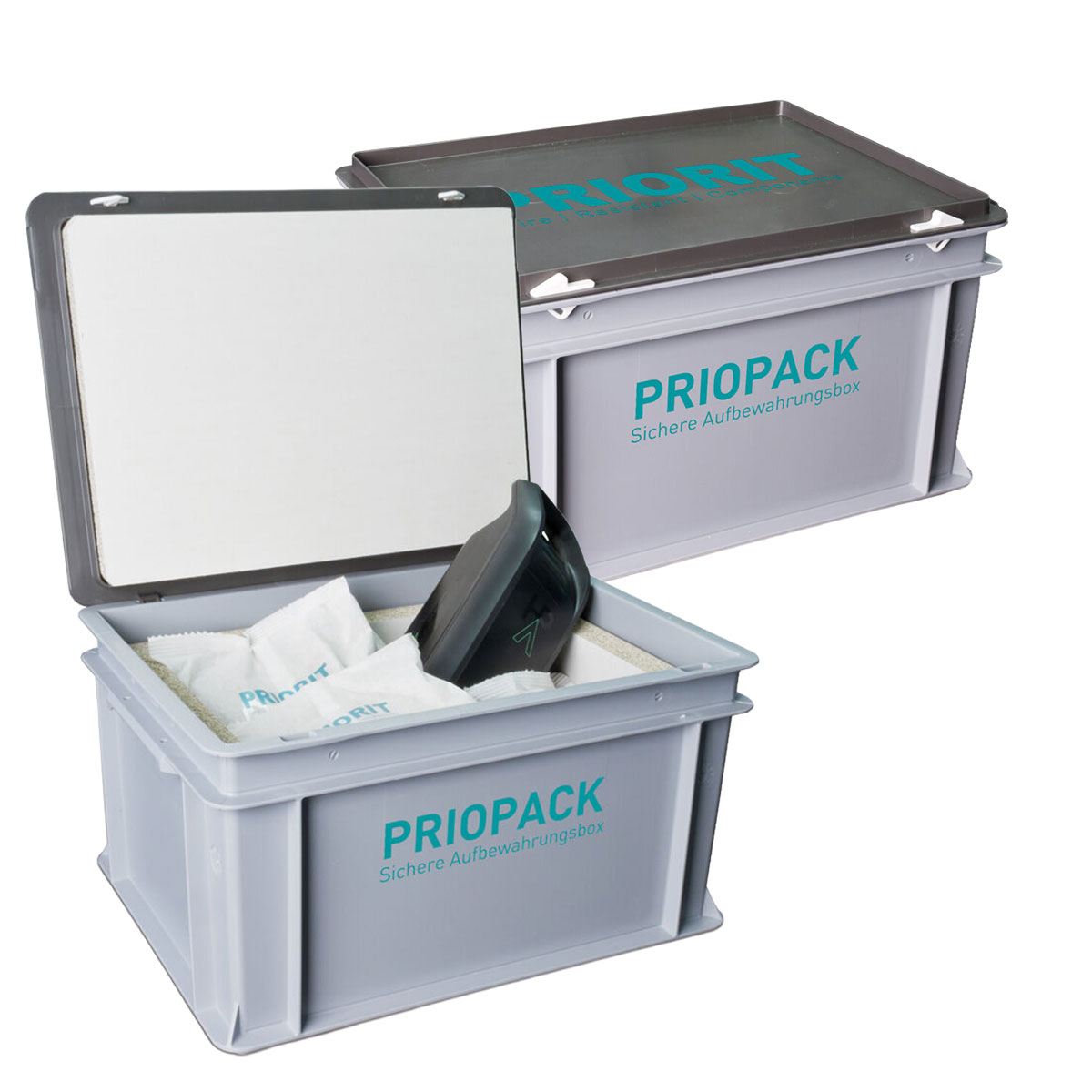


- External dimensions: 600 x 400 x 233 mm
- excluding filler material
- for batteries in as-new condition
Do you have some questions about this product?
- Your personal contact person
- Name: Petra Fürbeck
- E-Mail: info@lion-care.com
- Phone: +49 (0) 7151 - 256 4817
Technical data
| Areas of application: | E-Bike batteries, Loose cells, Model building batteries, Power tool batteries |
|---|---|
| Battery status: | New |
| Filling material: | Without filler material |
| Internal dimensions (mm): | 507 x 308 x 164 |
| Material: | Plastic |
| Material designation: | Polypropylene (PP) |
| Outer dimensions (mm): | 600 x 400 x 235 |
| Suitable for critically defective?: | No |
| Tipping weight (kg): | 15 |
Product information „Priorit PRIOPACK storage box“
Overview
The PRIOPACK large storage container is a solution for the safe storage and handling of lithium-ion batteries and lithium batteries. It has been specially developed for the storage of defective or damaged batteries posing an increased fire risk and helps to limit the effects of thermal runaway.
The storage container is lined on the inside with a non-combustible thermal insulation material and has a fire resistance rating of over 90 minutes.
Scope of delivery
Included in the scope of delivery:
- PRIOPACK storage container
- Hinged lid with snap-lock
Technical data
- External dimensions (L x W x H): 600 x 400 x 233 mm
- Internal dimensions (L x W x H): 507 x 308 x 164 mm
- Weight: 15 kg
- Material: Plastic
- Colour: Grey
- Fire resistance: > 90 minutes
- Internal lining: Non-combustible thermal insulation material
- Closure: Hinged lid with snap-lock
Scope of use & application
The large PRIOPACK storage container is suitable for companies and organisations that need to store and provide lithium-ion batteries safely.
Typical areas of application :
- Industry and manufacturing
- Workshops and service centres
- Battery and energy storage manufacturers
- Logistics centres
- Recycling facilities
- Testingand testing facilities
Suitable for :
- Defective lithium-ion batteries
- Damaged lithium batteries
- Temporary storage prior to disposal or further processing
Approvals
- The PRIOPACK large storage container is intended exclusively for storage.
Safety features
The large PRIOPACK storage container features various safety features for the safe storage of lithium batteries.
- Fire resistance of over 90 minutes
- Non-combustible thermal insulation material
- Reduction of toxic fumes
- Protection against thermal runaway
- Securely sealing lid
- Lid does not lift in the event of a fire
- Robust plastic construction
Summary
The large PRIOPACK storage container offers a safe solution for the storage of defective or damaged lithium-ion batteries posing an increased fire risk. The combination of a fire-resistant lining and a robust closure system helps to reduce the effects of thermal runaway and protect staff and the surrounding infrastructure.
| Areas of application: | E-Bike batteries, Loose cells, Model building batteries, Power tool batteries |
|---|---|
| Battery status: | New |
| Filling material: | Without filler material |
| Internal dimensions (mm): | 507 x 308 x 164 |
| Material: | Plastic |
| Material designation: | Polypropylene (PP) |
| Outer dimensions (mm): | 600 x 400 x 235 |
| Suitable for critically defective?: | No |
| Tipping weight (kg): | 15 |
Downloads
FAQ
That depends on various factors that need to be considered:
- size of the battery(ies)
- condition (e.g. non-critical, defective, critically defective or prototype)
- power
Transport boxes are available in many different sizes and specifications. The packaging group for which the box is suitable is indicated for each product.
Find out more in our blog article:
https://www.lion-care.com/aktuelles/blog/transportvorschriften-regeln-und-sicherheitsmassnahmen
Even if the batteries are not critical, remember to protect them from shocks and to order appropriate filling material if it is not already included in the box.
Yes. Should a battery reach a critical state and cause a fire, separating the batteries will prevent the fire from spreading and multiplying.
Generally, the insulation and protection material should line all sides of the container. The batteries are stored between individual layers.
We also have containers in our program that already have the protective material integrated into the outer wall. No further protective layer is necessary here.
The technical principles for storage and transportation solutions are very similar. The transport boxes are also subjected to extensive tests in accordance with ADR (drop test, fire test, etc.) to confirm compliance with the ADR regulations. The packaging regulations are extensive and regulated by law.
There are currently no comparable regulations for storage. Nevertheless, manufacturers of storage boxes regularly carry out appropriate tests.
The right container depends on the type and size of the battery to be shipped or stored.
If you want to learn more about battery storage and transportation, you will find the answers in our blog articles:
https://www.lion-care.com/aktuelles/blog/transportvorschriften-regeln-und-sicherheitsmassnahmen
https://www.lion-care.com/aktuelles/blog/lithium-ionen-akkus-sicherer-umgang-und-richtige-lagerung
The transportation of batteries is subject to ADR regulations.
The number, size and weight, energy density and condition of the batteries are crucial parameters for finding a suitable transport container for lithium-ion batteries. The selection process is complex and should be carried out by appropriately trained personnel. We have a trained hazardous materials officer on our team. Please feel free to contact us.
Plastic containers are cheaper but not as durable as metal containers. They are suitable, for example, for non-critical batteries, defective batteries, prototypes and end-of-life batteries. They can be used for both storage and transportation.
Metal containers are required, for example, when dealing with critically defective batteries.
The exact packaging instructions for these cases can be found in the ADR or by consulting a certified hazardous materials specialist.
To date, there are no legal requirements for the storage of lithium-ion batteries, which does not mean that they should be stored without suitable protective measures.
It is best to check with your insurer to find out which measures they recognize as suitable in the event of a claim.
For example, a suitable box could already be recognized as spatial separation.
A rough overview can be found in this VDS publication from the GDV:
https://shop. vds.de/download/vds-3103/ccb1d439-ad9d-47cb-a2b1-ace23e155610
Please also read our blog article on this topic:
https://www.lion-care.com/aktuelles/blog/lithium-ionen-akkus-sicherer-umgang-und-richtige-lagerung