
Recover-E-Bag – adaptable recovery and storage system for electric cars involved in accidents


- Intuitive and simple handling
- Low water consumption for extinguishing
- Secure storage location for 72 hours
- Versatile applications
Do you have some questions about this product?
- Your personal contact person
- Name: Petra Fürbeck
- E-Mail: info@lion-care.com
- Phone: +49 (0) 7151 - 256 4817
Technical data
| Dimensions (mm): | 5 200 x 2 300 x 900 |
|---|---|
| Included filler material: | without filler material |
| Material: | Polyester |
| Material designation: | 680 g/m² PVC fabric (POLYMAR®), double-sided coated |
| Packaging type: | Recovery systems |
| Storage instructions: | Store frost-free, dry, and dark in outer packaging. Protect strictly from moisture, mold, and weather! |
| Storage life: | 10 years |
| Temperature resistance: | -40 °C to +70 °C |
| Tensile Strength per Eyelet (kg): | approximately 1,500 |
| Tensile strength: | 3 000/3 000 N/50 mm according to DIN EN ISO 1421/V1 |
| Volume (l): | > 600 |
| Weight (kg): | about 20.5 |
Product information „Recover-E-Bag – adaptable recovery and storage system“
The growing number of electric cars on the roads is also leading to an increase in the number of fires involving electrically powered vehicles. Even long after a fire and the extinguishing of the electric car, vehicle batteries can reignite. This is prevented by cooling with water using the Recover-E-Bag. The adjustable contours reduce the amount of water required for extinguishing to a minimum.
If you are interested, please contact us for an individual quote. By email (info@lion-care.com), via the contact form or by telephone (07151 - 2564811).
Recover-E-Bag recovery system in a practical complete set
The Recover-E-Bag is available to purchase in a practical complete set, which includes all the necessary accessories, operating instructions and much more, providing you with a ready-to-use recovery system for electric cars. The set consists of two parts, weighing approximately 25 and 20 kg respectively. The dimensions of the bag are suitable for all standard cars. Each component in the set can be reordered individually. Please contact us for more information.
The recovery system for electric cars includes:
- 1 x Recover-E-Bag
- 1 x Training Bag (not for use!)
- 2 x tension straps with pointed hooks, blue (4 m)
- 2 x tension straps with pointed hooks, green (4 m)
- 1 x tension strap with pointed hook, red (6 m)
- 1 x tension strap with pointed hook, yellow (6 m)
- 1 x tension strap with pointed hook, orange (8 m)
- 4 x strap sling with pointed hook, black (0.6 m)
- 4 x anti-slip mat
- 1 x transport box for accessories
- 1 x transport bag for Recover-E-Bag
- 1 x operating instructions
- 1 x technical data sheet
Features and application of the Recover-E-Bag
The Recover-E-Bag can be used intuitively and easily with minimal training. It can be quickly and easily positioned and is suitable for all standard car sizes. The bag has a shelf life of 8-10 years, requires little space and maintenance, and is not subject to any inspection period. The low extinguishing water requirement of approx. 2500 litres and the consistent extinguishing water retention, in which contaminated water can be retained and disposed of properly, also serve to protect the environment. The system is easy to dispose of and does not require any further assistance from the fire brigade, as is necessary with fire extinguishing containers or similar equipment. Even in difficult visibility conditions, the handy system can be quickly put into position thanks to its intuitive colour design.
Use of the Recover-E-Bag to recover electric cars
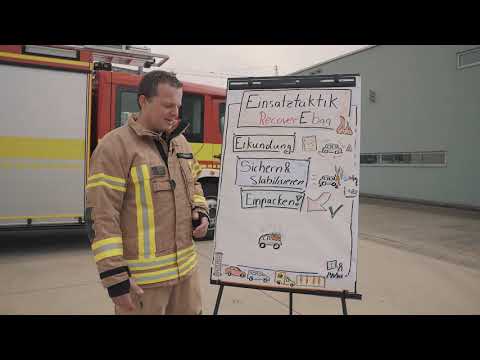
First, the vehicle must be secured and stabilised
.
The average surface temperature should not exceed 70 °C. Now the Recover-E-Bag can be prepared behind the electric car. The bag is pulled under the raised vehicle using the lashing straps. Once the vehicle is correctly aligned, it can be lowered into the tarpaulin. The Recover-E-Bag is then secured with the appropriate tension straps. The recovery system is then filled with water to above the upper edge of the high-voltage battery module. The secured vehicle can be transferred in the system to a tow truck, for example.
Take care with live parts, sloping terrain and icy surfaces. Protect the bag from sharp edges and pointed objects, as these may damage the fabric. If possible, always wear personal protective equipment when using the bag. In the event of a vehicle fire, the fire brigade should always be called for assistance.
Detailed operating instructions can be found under "Downloads".
Versatile applications
In addition to its use as a recovery and storage system, the Recover-E-Bag offers further applications. For example, it can be used for fire water retention, as a cover tarpaulin or as a mobile emergency fire water container for larger fires (e.g. forest fires).
The Recover-E-Bag is versatile and useful in many industries. For example, it is the best solution for fire brigades, towing companies, workshops and car dealerships.
Application for electric cars
The focus of the applications is particularly on fires involving electric cars. These have powerful Li-ion batteries, which pose a great danger to people and the environment in the event of a fire.
RuGo Bags – packaging specialist
The family-run company RuGo Bags GmbH stands for high-quality products and innovation. In addition to a wide range of packaging materials for office and industrial use, it also offers shipping, logistics and trade fair construction services. It has already collaborated with well-known companies in the automotive, hygiene and clay industries, medicine and injection moulding technology, the prefabricated house industry and internet service providers.
Efficient firefighting for electric vehicles – increasingly important in the future
The number of electric cars on the roads will continue to increase in the coming years. This will also increase the number of fires involving electrically powered vehicles. This poses a potential risk that should not be underestimated. Even long after a fire and the immediate extinguishing of the electric car, vehicle batteries can reignite. This is prevented by cooling with water from the Recover-E-Bag. The adjustable contours reduce the amount of water required for extinguishing to a minimum. In addition, the contaminated water is retained and can be disposed of properly.
At your service
Please do not hesitate to contact us if you have any questions. We look forward to hearing from you!
If you have any questions on this topic, please do not hesitate to contact us by email (info@lion-care.com), via the contact form or by telephone (07151 - 2564811).
| Dimensions (mm): | 5 200 x 2 300 x 900 |
|---|---|
| Included filler material: | without filler material |
| Material: | Polyester |
| Material designation: | 680 g/m² PVC fabric (POLYMAR®), double-sided coated |
| Packaging type: | Recovery systems |
| Storage instructions: | Store frost-free, dry, and dark in outer packaging. Protect strictly from moisture, mold, and weather! |
| Storage life: | 10 years |
| Temperature resistance: | -40 °C to +70 °C |
| Tensile Strength per Eyelet (kg): | approximately 1,500 |
| Tensile strength: | 3 000/3 000 N/50 mm according to DIN EN ISO 1421/V1 |
| Volume (l): | > 600 |
| Weight (kg): | about 20.5 |