
CEMO Charging Cabinet Basic 8/5 LockEX 2.0


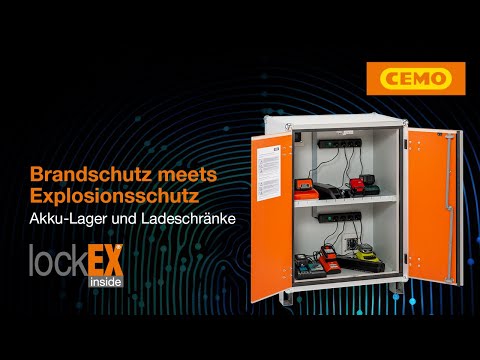
- Max. energy density: 3 kWh
- Includes 2 fire detectors
- Certified according to VDMA 24994
- 9 outlets at 230 V
Do you have some questions about this product?
- Your personal contact person
- Name: Petra Fürbeck
- E-Mail: info@lion-care.com
- Phone: +49 (0) 7151 - 256 4817
Technical data
| Fire resistance: | 60 min |
|---|---|
| Fire test procedure: | VDMA 24994 |
| Internal dimensions (mm): | 730 x 530 x 450 |
| Load function: | Yes |
| Number of doors: | 2-leaf hinged |
| Number of drawers: | 0 |
| Number of shelves: | 1 |
| Outer dimensions (mm): | 780 x 580 x 500 |
| Place of deployment: | Indoor area |
| Power supply: | 9 x 230 V / 50 Hz |
| Refractory: | Yes |
| Wardrobe type: | Freistehender Schrank, Under-sink cabinet |
| Weight (kg): | 85 |
Product information „CEMO Charging Cabinet Basic 8/5 LockEX 2.0“
Suitable Stacking Feet for the Battery Storage Cabinet
For optimal use of the battery storage cabinet, we recommend the appropriate stacking feet set for storage and charging cabinets. To order this directly, please select the appropriate variant.
In limited storage spaces, the problem often is that there is no space for large safety cabinets for storing lithium-ion batteries or they are too inflexible when space conditions in the warehouse change at short notice. CEMO offers the optimal solution here, which can be expanded at any time and can also be adapted to the needs of your operation.
Please feel free to contact us if you need a personalized offer.
Size, construction and function of the charging cabinet
The CEMO battery charging cabinet is, in this version, a storage and charging system. The external dimensions are 780 x 580 x 500 mm, the internal dimensions are 730 x 530 x 450 mm. The weight without feet is 85 kg, with feet 89 kg.
Direct comparison of the variants of the CEMO 8/5
| CEMO 8/5 Storage | CEMO 8/5 Basic | CEMO 8/5 Premium | CEMO 8/5 Premium Plus | |
| Outer dimensions | 810 x 580 x 520 mm | 780 x 580 x 500 mm | 810 x 660 x 520 mm | 880 x 660 x 520 mm |
| Inner dimensions | 730 x 530 x 450 mm | 730 x 530 x 450 mm | 730 x 530 x 450 mm | 730 x 530 x 450 mm |
| Unladen weight | 84 kg | 85 kg | 86 kg | 86 kg |
| Charging function | No | Yes | Yes | Yes |
| Power supply | / | 230 V | 230 V | 230 V |
| Warning system | Audible, battery-powered | Audible, battery-powered |
Audible, mains-powered Connection option via potential-free contact (Accessories: audible + visual) |
Audible, mains-powered Connection option via potential-free contact Remote alert via mobile phone (Accessories: audible + visual) |
| Stackable | Yes (max. 3-fold) | Yes (max. 3-fold) | Yes (max. 3-fold) | Yes (max. 3-fold) |
In the Basic version, the charging cabinet has two battery-powered acoustic smoke detectors, a power supply (9-outlet power strip 3500 W, 16 A) inside the cabinet and technical ventilation. In case of heat development, the circuit is interrupted by a no-power switch. When the door is opened, the power supply is also interrupted via a door contact switch. During charging, the doors should therefore always be kept closed.
Tested and certified according to VDMA standard 24994:2024-08 up to 3 kWh
According to VDMA 24994, the energy density may not exceed 3021.2 Wh in total and 1510.6 Wh per storage level.
VDMA 24994 is a test standard specifically for fire-resistant storage cabinets intended to securely store lithium-ion batteries. It tests whether the cabinet can withstand a so-called Thermal Runaway, i.e., dangerous overheating and self-ignition of the battery. It is important that the cabinet does not emit flames or toxic gases to the outside and that the door does not open even under pressure. The standard helps companies significantly increase safety when storing lithium-ion batteries and is increasingly recognized as an important benchmark by manufacturers and insurers.
MPA-tested fire resistance over 60 minutes from inside to outside
Additionally, a fire test was conducted for this system in accordance with EN 1363-1, demonstrating a fire resistance of over 60 minutes from inside to outside.
Equipped with the CEMO lockEX lock
With lockEX 2.0, CEMO presents the latest evolution stage in hazardous material storage. Designed for the highest safety requirements, the system provides effective protection without time limits – well beyond the market-standard 90 minutes.
CEMO lockEX is an innovative mechanism in the door locking that reliably relieves the pressure of ignitable gases inside the cabinet to prevent explosions.
The construction is based on an intelligent spring mechanism that, in the event of an explosion of a damaged Li battery, gently opens the cabinet doors to vent the resulting pressure, and immediately re-seals them safely.
Of particular importance is the protection afforded by the patent at the German Patent and Trademark Office. In professional circles it has long been known that lithium batteries can cause not only flames and explosive burning of individual cells, but also a gas explosion from leaked cell vapors. This represents the worst-case scenario of a battery fire, as it can, in case of doubt, negate the entire protective effect and thus be the decisive criterion in the hazard assessment.
CEMO lockEX combines fire protection and explosion protection in one product and provides a reliable solution for handling potentially dangerous battery fires.
The progression of a battery fire is effectively interrupted by the lockEX technology. Even before a Thermal Runaway begins, an explosion can occur. If the cabinet housing yields or the doors open, the protective effect can be immediately lost, and the burning cells and battery packs can be thrown unimpeded into the surroundings at the installation site.
The lockEX mechanism from CEMO ensures that the explosion pressure formed inside the cabinet is effectively managed. This advanced NO-BANG technology guarantees unrestricted preservation of the protective effect, even in the worst-case scenario of a battery fire.
Well equipped in the event of a accident
Particularly critically damaged lithium-ion cells can pose a serious danger to people and operating facilities in a fire. Dust generated by these fires can settle on circuit boards of production and operating equipment and cause long-term damage. This charging cabinet has an MPA-tested fire resistance of over 60 minutes from inside to outside in accordance with DIN EN 1363-1. A real battery fire test was conducted with an independent university. The supply and exhaust openings automatically close in a fire. The doors should always remain closed during use.
Robustly built
The charging cabinet is built from robust, fire-resistant components. Special fire protection seals prevent flame leakage and it features a cold-smoke-tight closure system for openings. The doors are double-leaf and lockable with sturdy latching and suspension. The door finish is orange, similar to RAL 2004, and the body is gray, similar to RAL 7035.
Portably usable
The container is transportable via the side carrying handles. With the optional stacking feet, the containers can be stored optimally up to a height of 3. The stacking feet also make it drivable. Optionally, the container can be equipped with an additional, fireproof and tested cable passage and connected to the house fire alarm system, for example.
Guidelines
There are currently no legal regulations for the storage of lithium batteries / lithium-ion cells. Only VdS Schadenverhütung GmbH provides general safety rules for damage prevention in its publication VdS 3103:2019-06 (03). It is advisable to clarify your requirements with your property insurer in advance.
The Manufacturer
The CEMO GmbH from Weinstadt has stood for safe storage with imagination and vigor for more than 60 years. The company is a pioneer in the field of modern transport and storage container technology and is one of the market leaders in this area.
Future-oriented
Lithium-ion batteries will be indispensable in all industrial applications in the coming years. However, when used improperly, they pose a significant hazard during manufacture, storage and transport. By purchasing this storage cabinet, you are securing yourself against larger financial damages from the outset.
For you in operation
Please feel free to contact us if you have any questions. We look forward to hearing from you!
| Fire resistance: | 60 min |
|---|---|
| Fire test procedure: | VDMA 24994 |
| Internal dimensions (mm): | 730 x 530 x 450 |
| Load function: | Yes |
| Number of doors: | 2-leaf hinged |
| Number of drawers: | 0 |
| Number of shelves: | 1 |
| Outer dimensions (mm): | 780 x 580 x 500 |
| Place of deployment: | Indoor area |
| Power supply: | 9 x 230 V / 50 Hz |
| Refractory: | Yes |
| Wardrobe type: | Freistehender Schrank, Under-sink cabinet |
| Weight (kg): | 85 |
Downloads
FAQ
Standard security cabinets are designed for indoor use, so they cannot be used outdoors.
The fire protection panels installed in the cabinets contain gypsum, which contains a lot of water, which expands when frozen. This deforms the panels. It can no longer be guaranteed that such a cabinet is still sealed or can withstand an explosion.
If you already have a suitable room that is structurally fire-resistant, then you do not necessarily need a safety cabinet to contain the fire.
However, please do not forget that the damage caused by a battery fire involves immense and also toxic contamination, the disposal of which can quickly lead to high costs.
In addition, you may not be able to continue working as usual until the damage has been finally repaired - depending on the location of the damage.
Accessory
Standard security cabinets are designed for indoor use, so they cannot be used outdoors.
The fire protection panels installed in the cabinets contain gypsum, which contains a lot of water, which expands when frozen. This deforms the panels. It can no longer be guaranteed that such a cabinet is still sealed or can withstand an explosion.
If you already have a suitable room that is structurally fire-resistant, then you do not necessarily need a safety cabinet to contain the fire.
However, please do not forget that the damage caused by a battery fire involves immense and also toxic contamination, the disposal of which can quickly lead to high costs.
In addition, you may not be able to continue working as usual until the damage has been finally repaired - depending on the location of the damage.
Accessories

Stacking feet set for CEMO storage and charging cabinets. The set consists of 4 metal feet, making the cabinets rollable and stackable in 3 layers. This increases the height by 10 cm. The set comes complete with screws and metal plates to prevent sideways slipping. The set is highly recommended as it greatly improves the handling of the storage and charging cabinets.

Networkable smoke alarm (acoustic) in a set of 2. The smoke alarm is included as standard in "Storage" and "Shop Basics".

Shelf (for base level or as intermediate level)* Dimensions cm (W x D x H): 67 x 40 x 3.5, * Dividers for shelves available on request Ideal for making full use of space and increasing storage area for small-cell lithium batteries

The shelf levels can be easily adjusted to the perfect working height and the cabinets can be easily inserted using a high-lift truck or forklift. The shelf comes with mounting materials for wall mounting.

Additional, fireproof cable entry with a fire resistance of 60 minutes for CEMO storage and charging cabinets. Ideal, for example, for connection to the in-house fire alarm system.

Aerosol extinguishing agent for lithium batteries, suitable for initial rapid extinguishing and flame suppression, automatic pyrotechnic activation, no maintenance required.

Perfect for evacuating in the event of an accident and for easy repositioning. Two of the four swivel castors have an integrated foot brake.