

When does a battery explode?
Alongside the numerous advantages, a lithium-ion battery can also pose a real danger, especially if the battery starts to burn or, even more seriously, if a battery explodes. But when does a battery explode and how can this be prevented? The causes and corresponding prevention measures are explained below. The following points are primarily addressed:
What is the cause of an exploding battery?
A high-quality and intact battery does not explode by itself, but in this scenario usually several factors come together, which in the worst case can lead to an explosion (but do not have to). Typically, a battery explodes after a defect or mechanical damage when it is continued to be used and (improperly) charged.
Damage to the battery - specifically the separator layer - is the beginning of the problem
Severe problems with a battery usually occur when the separator layer inside the battery is damaged. A Li-ion battery is designed so that the cathode and anode layers are separated by an extremely thin layer called the separator. Damage to this inner layer can lead to short circuits and thus uncontrolled energy discharges. The causes can vary: physical impact from shocks, drops, etc., which can damage this layer (which, for example, can lead to explosions in e-bike batteries), but manufacturing defects, inferior material quality, etc. are also possible causes for such damage.
Chain reaction of the cells (Thermal Runaway) leads to explosion
With such damage to the separator layer and the subsequent short circuit, a lot of energy can be released in a short time, which in turn leads to extremely high heat development. The electrolytes contained in the lithium-ion battery catch fire and a fire occurs. This can then trigger an uncontrolled chain reaction, the so-called “Thermal Runaway”: The decomposition of the electrolyte releases further energy and, internally at the cathode, oxygen is released, which accelerates the exothermic reaction in the shortest possible time. This creates a self-reinforcing loop that makes the battery explode and the normal extinguishing of batteries is then no longer possible.
The battery does not have to explode immediately after damage
The tricky thing about this effect: There does not have to be a direct temporal connection between the damage to the separator layer and the explosion, i.e. the separator layer is often damaged, but the explosion occurs much later. Thus, a problem can gradually build up, which eventually leads to the exploding battery.
Prevention is particularly important
An exploding battery is the greatest danger posed by this energy carrier. While a battery fire can still be extinguished and thus environmental damage minimized, an explosion always represents an extremely large risk – for property, but in the worst case also for one's own health. All the more important are preventive measures to prevent a battery explosion from happening in the first place.
How can one prevent a battery explosion?
The good news first: An exploding lithium-ion battery is fortunately extremely rare. If you pay attention to a few things during use and storage, you can further minimize the risk, which are explained below.
- The proper charging of a lithium-ion battery
- The correct storage of batteries
- Never use or charge defective/damaged batteries.
The proper charging of a lithium-ion battery
When charging a battery, the temperature in the individual battery cells also rises, so this period always involves a potential increase in risk. In intact batteries, however, this temperature rise is completely unproblematic and especially medium and large batteries also always have built-in charging management systems that regulate the temperature and interrupt or adjust charging if the deviation from target values is too large.
Only manufacturer-approved charging devices
With improper charging, for example rapid charging of batteries that are not suitable for it or the use of chargers that are not approved for the respective batteries, charging can become dangerous. The consequence can then be strong heating of the batteries and the consequences can be a fire or an exploding battery. All the more important is to always charge intact batteries only in a protected environment, such as in suitable battery bags, for example.
The correct storage of batteries
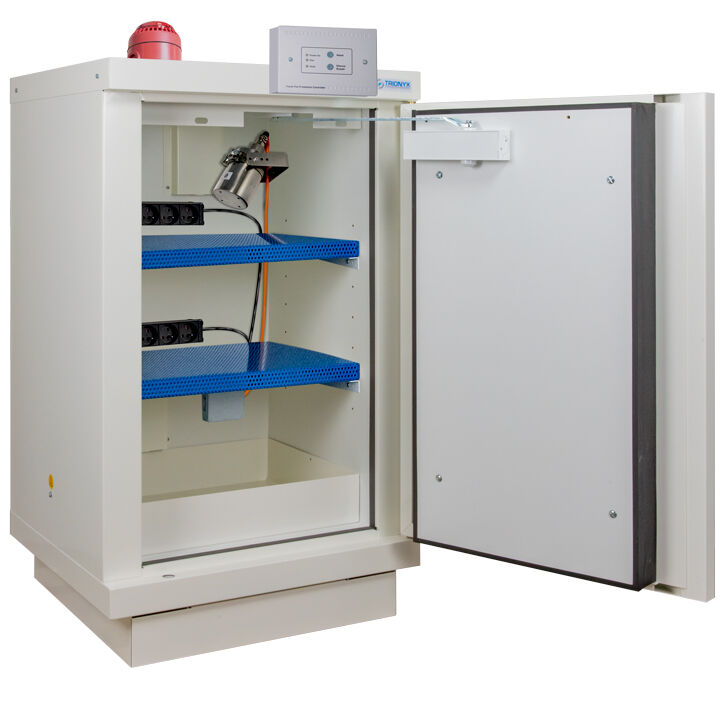 Due to the potential dangers primarily emanating from defective batteries, safe and correct storage of batteries throughout the year is of particular importance. There are several options for this, for example in suitable fireproof battery bags, but also in battery boxes up to security cabinets for batteries, which typically have fire protection ratings and thus provide good protection for the surroundings in the event of a battery fire or even an explosion.
Never use or charge defective/damaged batteries
As explained above, mechanical defects are often the cause of the explosion of a lithium-ion battery. Therefore one of the most important preventive measures is to never use or charge defective, deformed, or otherwise impaired batteries, because the risk of explosion increases sharply.
In general, intact lithium batteries, when charged with the right devices and properly, do not pose an increased danger. However, you cannot always tell from the outside whether a lithium battery is completely intact. Accordingly, it is recommended to always charge lithium-ion batteries and lithium batteries in appropriately secured environments.