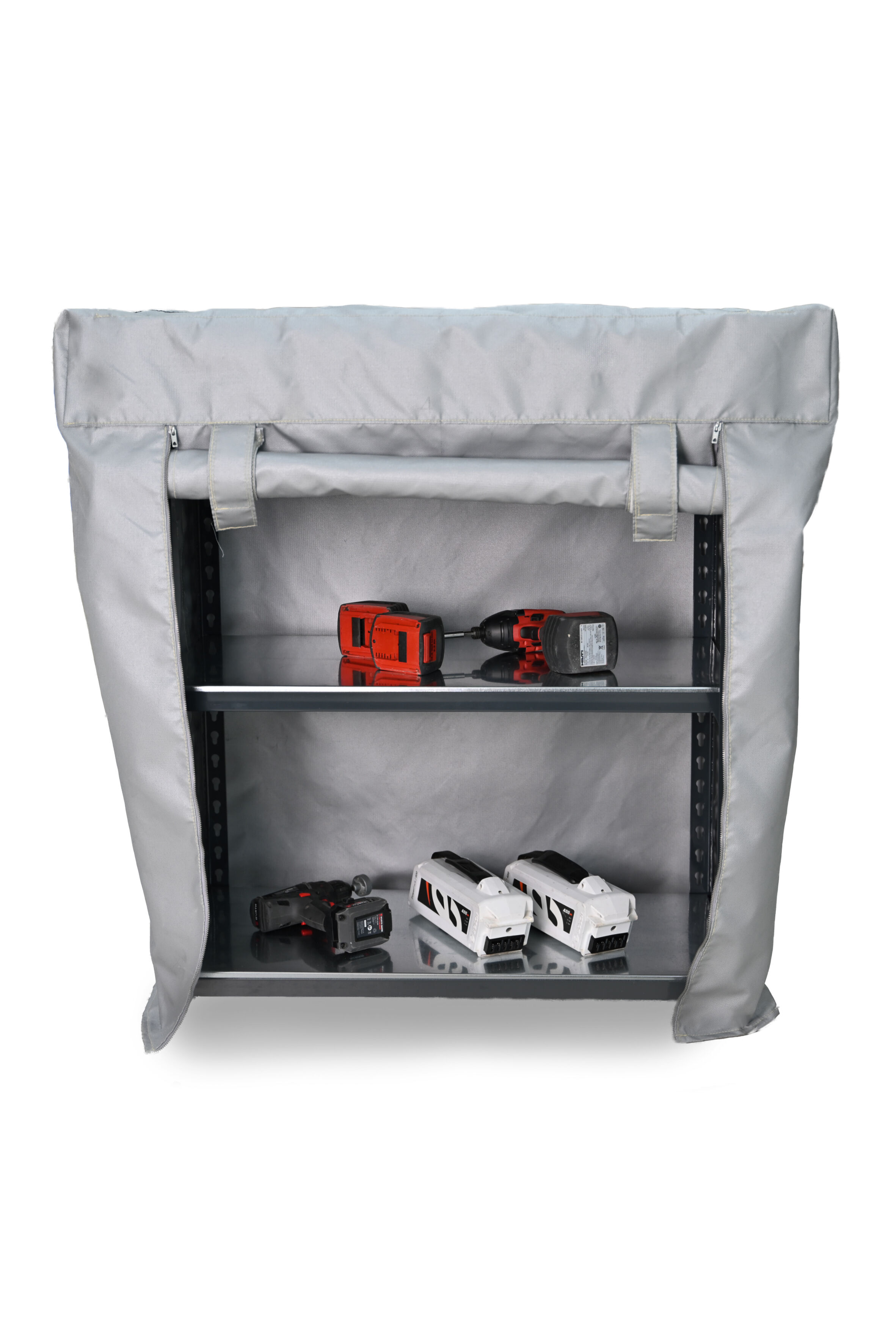
VLITEX battery-safe rack L / battery rack with fire containment hood


- External dimensions: 1800 x 800 x 400 mm
- Temperature resistance: 1000 °C
- Short-term temperature resistance: 1750 °C
Do you have some questions about this product?
- Your personal contact person
- Name: Petra Fürbeck
- E-Mail: info@lion-care.com
- Phone: +49 (0) 7151 - 256 4817
Technical data
| Cabinet type: | Freestanding cabinet |
|---|---|
| Charging function: | No |
| Fire resistance: | 1 000° C, KIWA test in accordance with DIN SPEC 91489, 1,750° C, internal test report, non-combustible in the sense of DIN EN 13501, MPA |
| Number of shelves: | 5 |
| Outer dimensions (mm): | 800 x 400 x 1 800 |
| Place of deployment: | Indoor area |
| Refractory: | Yes |
| Weight (kg): | 21.5 |
Product information „VLITEX battery-safe rack L / battery rack with fire containment hood“
This system is an innovative storage system for lithium-ion rechargeable batteries and batteries. This innovative shelving system was developed by VLITEX to prevent damage caused by damaged battery cells. Fumes and toxic vapors can permanently damage surrounding electronic devices. The "L" model of the battery safe shelf offers a safe solution against these and other potential dangers that can arise from lithium-ion cells passing through (thermal runaway). Contact us for a customized offer.
Tested safety features for industrial applications
The outstanding fire resistance and high standards in smoke minimization make this enclosure system ideal for use in industrial applications. Certifications and tests by institutions such as the Saxon Textile Research Institute (STFI) and KIWA underline the high temperature resistance of up to 1,750 °C. In the long term, the fire protection hood has a temperature resistance of 1,000 °C.
Size, storage capacity and function of the safety cabinet
The Akku-Safe Shelf L has external dimensions of 1,800 x 800 x 400 mm (height x width x depth). The empty weight is 21.5 kg, while the cover weighs a further 2.5 kg. The cabinet has 5 shelves, each of which can carry a maximum weight of 180 kg, with a maximum total weight of 720 kg. The fabric of the fire protection cover is made of HT glass fiber and has a special polymer coating, while the shelf itself is made of metal. The Battery Safe Shelf L is ideal for storing and charging small battery-powered devices such as e-bike batteries and it is recommended that the shelf is securely fastened to a wall with at least two screws.
High level of safety
The design of the rack effectively minimizes the spread of smoke and toxic gases and provides additional explosion protection. The materials of the cabinet are non-flammable and guarantee high cut protection and low electrical resistance.
Certifications and guidelines
The system has been extensively tested, including burst resistance tests in accordance with BS EN ISO 13938-2:2019 and temperature tests (KIWA test) which promise a temperature resistance of 1,000 °C.
Future-oriented and safe
Lithium-ion batteries are indispensable in modern applications. With this cabinet system from VLITEX, you can protect your investments and safeguard yourself against potential risks.
We are here for you
Do you have any questions or need more information? Feel free to contact us - we look forward to hearing from you!
| Cabinet type: | Freestanding cabinet |
|---|---|
| Charging function: | No |
| Fire resistance: | 1 000° C, KIWA test in accordance with DIN SPEC 91489, 1,750° C, internal test report, non-combustible in the sense of DIN EN 13501, MPA |
| Number of shelves: | 5 |
| Outer dimensions (mm): | 800 x 400 x 1 800 |
| Place of deployment: | Indoor area |
| Refractory: | Yes |
| Weight (kg): | 21.5 |
Downloads
FAQ
Unfortunately not. Fires caused by lithium-ion batteries are chemical fires that are independent of oxygen. They continue to burn even if they are deprived of oxygen or if you try to extinguish them with water as you would conventionally.
Nevertheless, the fire brigade uses water to cool the burning battery. Even after hours, a battery can ignite again.
The only thing that helps here is a controlled burn-off and fire containment to prevent the fire from spreading to the surrounding area due to high temperatures or escaping flames.
The name “fire blanket” is common, but misleading. These special, high-temperature-resistant blankets do not extinguish battery fires. What works on the grill does not work on lithium batteries.
With fire blankets, the name says it all: they contain the fire and thus also the damage, giving you time to alert the local fire brigade, who will decide on further fire-fighting measures.
Find out more about this topic in our blog articles:
https://www.lion-care.com/aktuelles/blog/brandbekaempfungsstrategien-fuer-elektrofahrzeuge
https://www.lion-care.com/aktuelles/blog/akku-braende-bekaempfen-kuehlen-kontrollieren-oder-abwarten
The German DIN SPEC 91489 provides clarity for stakeholders in various industries.
DIN SPEC 91489 contains several requirements for fire-retardant ceilings, the most important of which are listed below:
- General requirements
Properties such as loops, size of the blanket, storage, etc. are mentioned. - Thermal resistance
The DIN SPEC requires a minimum ISO13591-1 classification B. However, the Fire Isolator fire blankets have a higher (the highest) classification: A1. - Mechanical stability
Resistance to cutting, stability of loops, etc. - Electrostatic charge
- Protection against electric shock
- Chemical resistance
- Markings
- Manufacturer information
- Minimum content of the test report
- Training for use by first responders
DIN SPEC 91489 requires that fire blankets can be used quickly and easily by two trained responders wearing personal protective equipment and breathing apparatus.
In the event of a battery fire, such a blanket provides valuable time to alert the fire department and prevent the flames from spreading. This applies to all possible uses, be it a cell phone, a laptop, an e-scooter, a factory robot or an electric car.
This question will be answered by the local fire department, because they are always to be alerted and they initiate further fire-fighting measures.
It is highly dangerous to let a burning electric car burn out under such a blanket and wait until it is all over. A battery fire could last for days and reignite repeatedly. Among other things, the fire produces toxic gases that must be contained as quickly as possible.
The right size of fire blanket depends largely on the size of the burning object and its size. An e-scooter requires a smaller blanket than an e-car or a forklift.
Roughly measure how large the blanket needs to be so that it still lies flat on the ground around the object, with a 1-2m overhang. Don't forget to take the height into account (e.g. SUV). This is the only way to ensure that toxic gases remain under the blanket for the most part and that flames have no chance of igniting the area around the source of the fire.
Here are some examples of common sizes:
Automobiles:
Larger vehicles such as station wagons, SUVs, sedans, forklifts: The fire blanket should be at least 6x8 meters (taking into account the height of the vehicle).
Medium-sized vehicles: The fire blanket should be at least 5x6m in size.
Smaller electric vehicles, e.g. warehouse robots: The fire blanket should be at least 3x4m in size.
Appliances with batteries, such as cordless screwdrivers, garden tools: The fire blanket should be at least 1.5x1.5m in size.
Cell phones and laptops: The fire blanket should be at least 1.5x1.5m in size.
There are also differences in the materials used. The fire blankets differ, for example, in their composition, material thickness and temperature resistance. This is crucial, for example, if the blankets are to be used directly on batteries, not installed, as in vehicles.
When making your purchase, don't forget the weight of the blankets. A large blanket can quickly weigh 25-45 kg. Here, for example, there is the option of storing it in a trolley.
In the event of a fire and the active use of the blanket, no. We strongly advise against it. Firstly, the extreme temperatures can cause damage to the material that cannot be reliably assessed by laypersons. Secondly, fires produce toxic gases that are harmful to health and can adhere to the material.
The ceiling can be used repeatedly for protection if there is no damage.
Here, too, the size and the fire behavior of the object are crucial. An e-bike battery reaches different temperatures than the fire of an electric car.
When an electric vehicle catches fire, temperatures of up to 1,000°C can be reached – and even peaks of 1,200°C for a short time.
Due to the different fire behavior, it is not possible to make an accurate statement about the temperatures that will arise and the duration of the fire.
Unfortunately not. Fires caused by lithium-ion batteries are chemical fires that are independent of oxygen. They continue to burn even if they are deprived of oxygen or if you try to extinguish them with water as you would conventionally.
Nevertheless, the fire brigade uses water to cool the burning battery. Even after hours, a battery can ignite again.
The only thing that helps here is a controlled burn-off and fire containment to prevent the fire from spreading to the surrounding area due to high temperatures or escaping flames.
The name “fire blanket” is common, but misleading. These special, high-temperature-resistant blankets do not extinguish battery fires. What works on the grill does not work on lithium batteries.
With fire blankets, the name says it all: they contain the fire and thus also the damage, giving you time to alert the local fire brigade, who will decide on further fire-fighting measures.
Find out more about this topic in our blog articles:
https://www.lion-care.com/aktuelles/blog/brandbekaempfungsstrategien-fuer-elektrofahrzeuge
https://www.lion-care.com/aktuelles/blog/akku-braende-bekaempfen-kuehlen-kontrollieren-oder-abwarten
The German DIN SPEC 91489 provides clarity for stakeholders in various industries.
DIN SPEC 91489 contains several requirements for fire-retardant ceilings, the most important of which are listed below:
- General requirements
Properties such as loops, size of the blanket, storage, etc. are mentioned. - Thermal resistance
The DIN SPEC requires a minimum ISO13591-1 classification B. However, the Fire Isolator fire blankets have a higher (the highest) classification: A1. - Mechanical stability
Resistance to cutting, stability of loops, etc. - Electrostatic charge
- Protection against electric shock
- Chemical resistance
- Markings
- Manufacturer information
- Minimum content of the test report
- Training for use by first responders
DIN SPEC 91489 requires that fire blankets can be used quickly and easily by two trained responders wearing personal protective equipment and breathing apparatus.
In the event of a battery fire, such a blanket provides valuable time to alert the fire department and prevent the flames from spreading. This applies to all possible uses, be it a cell phone, a laptop, an e-scooter, a factory robot or an electric car.
This question will be answered by the local fire department, because they are always to be alerted and they initiate further fire-fighting measures.
It is highly dangerous to let a burning electric car burn out under such a blanket and wait until it is all over. A battery fire could last for days and reignite repeatedly. Among other things, the fire produces toxic gases that must be contained as quickly as possible.
The right size of fire blanket depends largely on the size of the burning object and its size. An e-scooter requires a smaller blanket than an e-car or a forklift.
Roughly measure how large the blanket needs to be so that it still lies flat on the ground around the object, with a 1-2m overhang. Don't forget to take the height into account (e.g. SUV). This is the only way to ensure that toxic gases remain under the blanket for the most part and that flames have no chance of igniting the area around the source of the fire.
Here are some examples of common sizes:
Automobiles:
Larger vehicles such as station wagons, SUVs, sedans, forklifts: The fire blanket should be at least 6x8 meters (taking into account the height of the vehicle).
Medium-sized vehicles: The fire blanket should be at least 5x6m in size.
Smaller electric vehicles, e.g. warehouse robots: The fire blanket should be at least 3x4m in size.
Appliances with batteries, such as cordless screwdrivers, garden tools: The fire blanket should be at least 1.5x1.5m in size.
Cell phones and laptops: The fire blanket should be at least 1.5x1.5m in size.
There are also differences in the materials used. The fire blankets differ, for example, in their composition, material thickness and temperature resistance. This is crucial, for example, if the blankets are to be used directly on batteries, not installed, as in vehicles.
When making your purchase, don't forget the weight of the blankets. A large blanket can quickly weigh 25-45 kg. Here, for example, there is the option of storing it in a trolley.
In the event of a fire and the active use of the blanket, no. We strongly advise against it. Firstly, the extreme temperatures can cause damage to the material that cannot be reliably assessed by laypersons. Secondly, fires produce toxic gases that are harmful to health and can adhere to the material.
The ceiling can be used repeatedly for protection if there is no damage.
Here, too, the size and the fire behavior of the object are crucial. An e-bike battery reaches different temperatures than the fire of an electric car.
When an electric vehicle catches fire, temperatures of up to 1,000°C can be reached – and even peaks of 1,200°C for a short time.
Due to the different fire behavior, it is not possible to make an accurate statement about the temperatures that will arise and the duration of the fire.