
JUTEC fire protection set
Fire blanket / fire blanket for electric cars & combustion engines



incl. VAT.
Please note: Notes on delivery time
Free shipping (Germany, mainland)!
Shippingtime: approx. 5 workdays
- Article no: JUTLOBBD09X10

Questions about the article?
Our staff member Petra Fürbeck is happy to help you:
+49 (0) 7151 - 256 4817 or info@lion-care.com
| Permeable to water?: | Yes |
| Suitable for: | Small appliances and rechargeable batteries |
| Dimensions (mm): | 900 x 1 000, 900 x 2 000 |
| Heat resistance (permanent) ° C: | 1 150 |
| Heat resistance (short term) ° C: | 1 300 |
| Weight (kg): | 1,3, 2,45 |
1. Brief overview
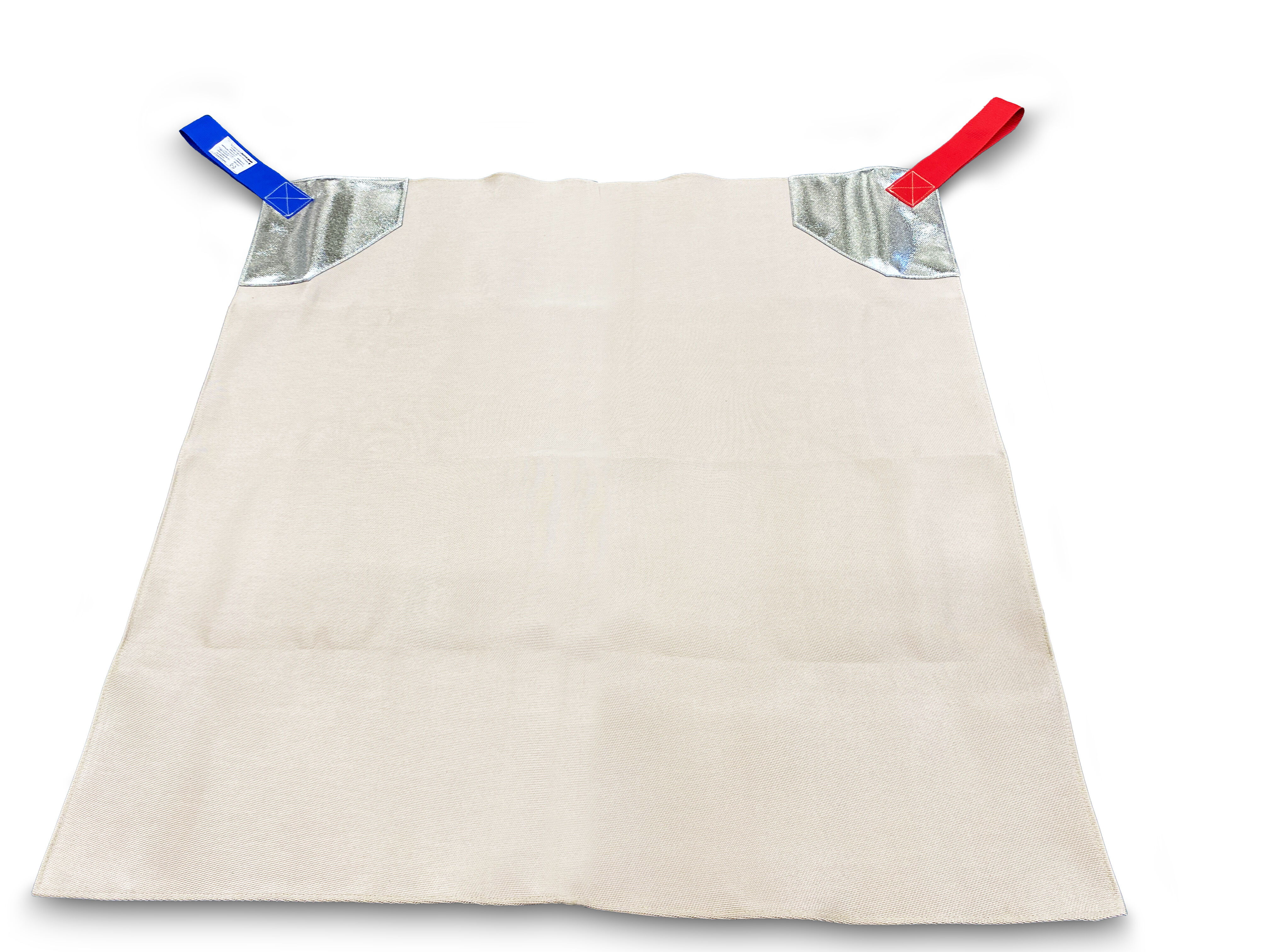
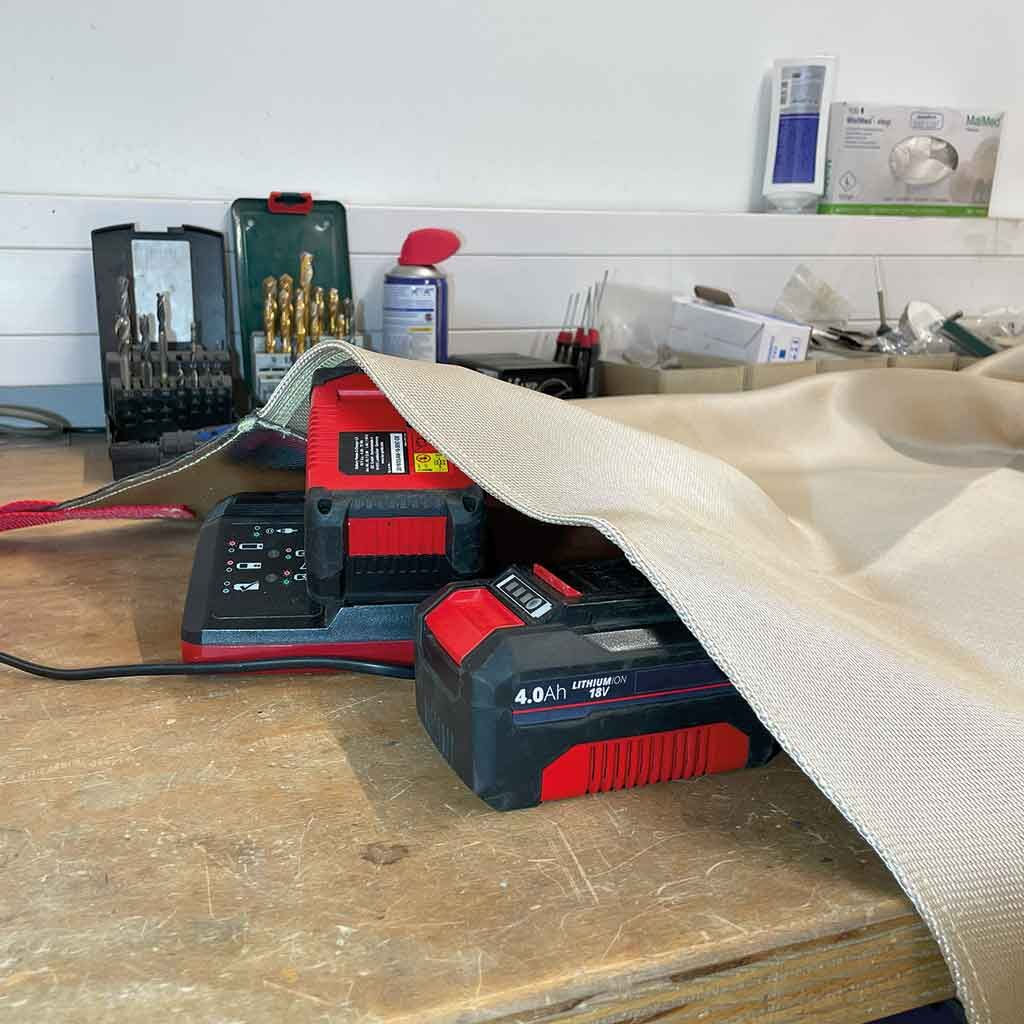
The JUTEC fire blanket (hereinafter also referred to synonymously as fire blanket or fire protection blanket) is designed to cover damaged or burning devices with lithium-ion batteries. It is used to isolate flames under the blanket in the best possible way, to reduce the spread of smoke, toxic gases and contaminated extinguishing water, to lower the temperature and to limit explosions under the blanket.
Fires involving lithium-ion batteries pose a particular challenge, as conventional fire extinguishers often reach their limits here. The fire containment blanket offers a simple, quickly deployable option for containing a fire source and thus protecting the surrounding area.
Please note: The term "fire blanket" is often used in common parlance. In technical terms, this is a fire containment or fire protection blanket - the fire is primarily contained, not actively extinguished.
2. Areas of application & conditions of use
- Fire containment and enclosure of fires or sources of fire with lithium-ion batteries
- Suitable for:
- Devices such as laptops, tools, cordless screwdrivers and other battery-operated devices
-
Use as a heat shield and for controlled containment of battery fires:
- Containment of flames
- Reduction of smoke and gas emissions
- Limits the temperature in the surrounding area
-
Suitable for preventive use, e.g. for covering functional but endangered batteries during storage to prevent the possible spread of fire.
Note on the standard situation ("fire blanket"):
The European standard DIN EN 1869:2019-10 refers to fire blankets for grease and cooking oil fires (deep-frying fats up to 3 l). The fire blanket offered here is not certified according to this standard and is not intended for cooking oil and cooking fat fires. The intended use is the containment or limitation of Li-ion battery fires.
3. Technical data
3.1 Material & structure
- Material: High temperature fabric
- Coating: Mineral coating
- Grammage: approx. 1,250 g/m²
- Material thickness: approx. 1.4 mm
- Properties:
- Non-flammable
- Cooling effect due to absorption of extinguishing water
- Minimizes the release of toxic gases and contaminated extinguishing water
- Prevents ballooning
- Non-conductive
3.2 Temperature resistance
- Short-term temperature resistance: up to 1,300 °C
- Long-term temperature resistance: 1,000 °C
3.3 Overview of variants
The fire protection blanket is available in several sizes:
| 0,9 x 1 | 0,9 x 2 | |
| Dimensions | 0.9 x 1 m | 0.9 x 2 m |
| Weight | approx. 1.3 kg | approx. 2.45 kg |
| Suitable for | Tool batteries, small appliances, etc. | Tool batteries, small appliances, etc. |
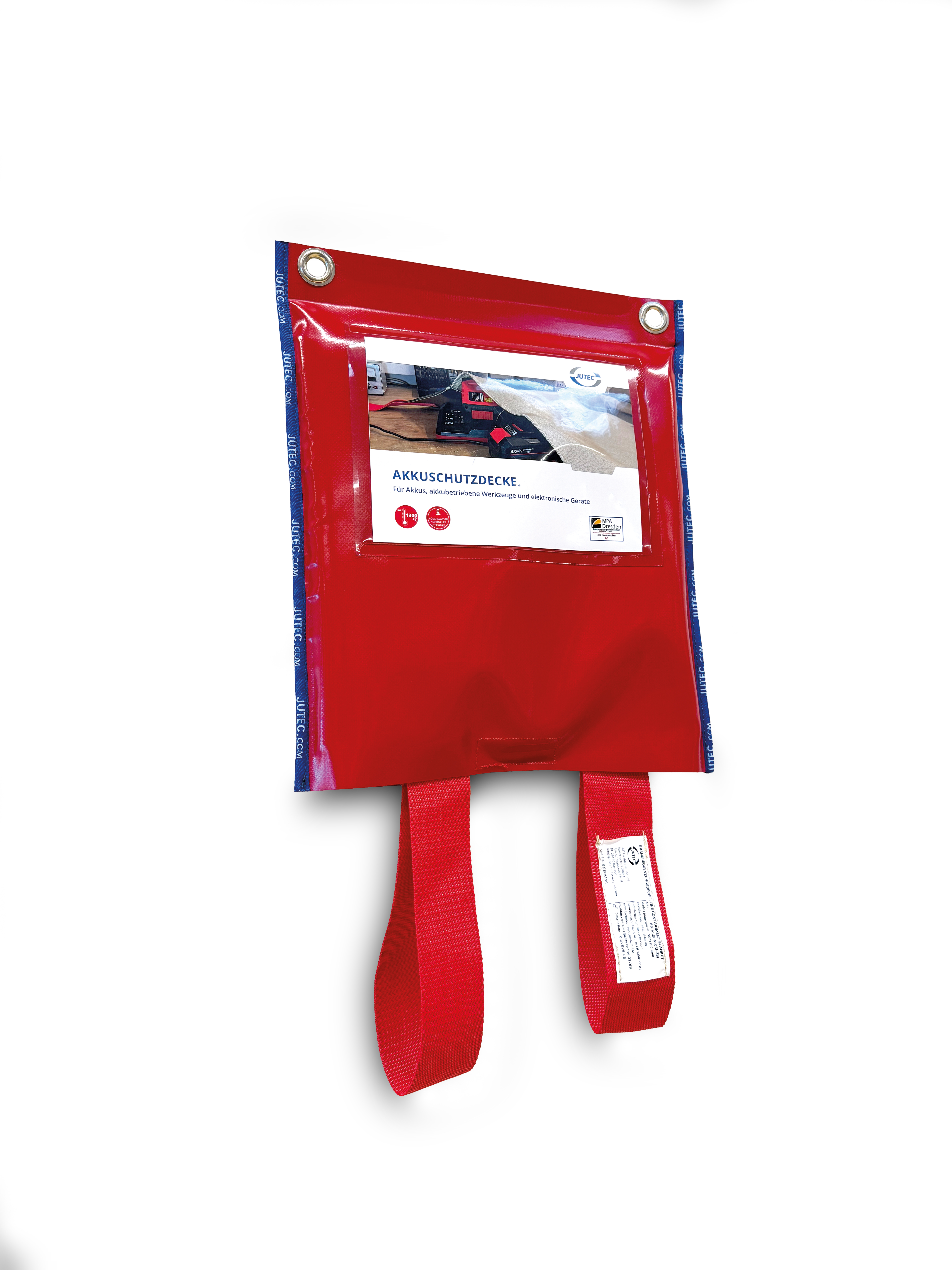
| Bag | 33 x 39 cm | 38.5 x 52 cm |
| Handle loops | 2 | 4 |
Note: Size and weight specifications with approx. ±5 % tolerance.
4. Approvals & safety features
- Conforms to DIN SPEC 91489 (fire protection blankets for lithium-ion batteries)
- Non-combustible in accordance with DIN EN 13501-1 (A1)
- Non-conductive (DIN 54345-1)
5. Notes on use & operation
Basic principle of use:
- The blanket can be quickly pulled out of the wall-mounted pocket by the loops.
- The blanket is carefully pulled over the burning or endangered object by the loops.
- Depending on the fire load, the fire is usually smothered or significantly contained within a short time.
- In order to support sufficient cooling (below approx. 100 °C), the blanket should remain on the object for as long as possible.
Important notes:
- After removing the blanket, check that there is no re-ignition - even individual battery cells can react again with a time delay.
- If possible, always use personal protective equipment (PPE).
- The fire department should always be called in the event of a fire.
Storage/storage:
- Store blankets in the bag provided (hanging on the wall).
- Store in a dry place; do not place any loads directly on the blanket.
6. Conclusion
The fire blanket is designed to contain and limit fires in connection with lithium-ion batteries. Thanks to its heat-resistant fabric with mineral coating, tested temperature resistance and electrical insulation effect, it supports controlled burning behavior and the reduction of smoke and gas release.
7. In use for you
If you have any questions, please do not hesitate to contact us. We look forward to exchanging ideas with you.
| Permeable to water?: | Yes |
| Suitable for: | Small appliances and rechargeable batteries |
| Dimensions (mm): | 900 x 1 000, 900 x 2 000 |
| Material: | High temperature fabric |
| Heat resistance (permanent) ° C: | 1 150 |
| Heat resistance (short term) ° C: | 1 300 |
| Weight (kg): | 1,3, 2,45 |
Unfortunately not. Fires caused by lithium-ion batteries are chemical fires that are independent of oxygen. They continue to burn even if they are deprived of oxygen or if you try to extinguish them with water as you would conventionally.
Nevertheless, the fire brigade uses water to cool the burning battery. Even after hours, a battery can ignite again.
The only thing that helps here is a controlled burn-off and fire containment to prevent the fire from spreading to the surrounding area due to high temperatures or escaping flames.
The name “fire blanket” is common, but misleading. These special, high-temperature-resistant blankets do not extinguish battery fires. What works on the grill does not work on lithium batteries.
With fire blankets, the name says it all: they contain the fire and thus also the damage, giving you time to alert the local fire brigade, who will decide on further fire-fighting measures.
Find out more about this topic in our blog articles:
https://www.lion-care.com/aktuelles/blog/brandbekaempfungsstrategien-fuer-elektrofahrzeuge
https://www.lion-care.com/aktuelles/blog/akku-braende-bekaempfen-kuehlen-kontrollieren-oder-abwarten
The German DIN SPEC 91489 provides clarity for stakeholders in various industries.
DIN SPEC 91489 contains several requirements for fire-retardant ceilings, the most important of which are listed below:
- General requirements
Properties such as loops, size of the blanket, storage, etc. are mentioned. - Thermal resistance
The DIN SPEC requires a minimum ISO13591-1 classification B. However, the Fire Isolator fire blankets have a higher (the highest) classification: A1. - Mechanical stability
Resistance to cutting, stability of loops, etc. - Electrostatic charge
- Protection against electric shock
- Chemical resistance
- Markings
- Manufacturer information
- Minimum content of the test report
- Training for use by first responders
DIN SPEC 91489 requires that fire blankets can be used quickly and easily by two trained responders wearing personal protective equipment and breathing apparatus.
In the event of a battery fire, such a blanket provides valuable time to alert the fire department and prevent the flames from spreading. This applies to all possible uses, be it a cell phone, a laptop, an e-scooter, a factory robot or an electric car.
This question will be answered by the local fire department, because they are always to be alerted and they initiate further fire-fighting measures.
It is highly dangerous to let a burning electric car burn out under such a blanket and wait until it is all over. A battery fire could last for days and reignite repeatedly. Among other things, the fire produces toxic gases that must be contained as quickly as possible.
The right size of fire blanket depends largely on the size of the burning object and its size. An e-scooter requires a smaller blanket than an e-car or a forklift.
Roughly measure how large the blanket needs to be so that it still lies flat on the ground around the object, with a 1-2m overhang. Don't forget to take the height into account (e.g. SUV). This is the only way to ensure that toxic gases remain under the blanket for the most part and that flames have no chance of igniting the area around the source of the fire.
Here are some examples of common sizes:
Automobiles:
Larger vehicles such as station wagons, SUVs, sedans, forklifts: The fire blanket should be at least 6x8 meters (taking into account the height of the vehicle).
Medium-sized vehicles: The fire blanket should be at least 5x6m in size.
Smaller electric vehicles, e.g. warehouse robots: The fire blanket should be at least 3x4m in size.
Appliances with batteries, such as cordless screwdrivers, garden tools: The fire blanket should be at least 1.5x1.5m in size.
Cell phones and laptops: The fire blanket should be at least 1.5x1.5m in size.
There are also differences in the materials used. The fire blankets differ, for example, in their composition, material thickness and temperature resistance. This is crucial, for example, if the blankets are to be used directly on batteries, not installed, as in vehicles.
When making your purchase, don't forget the weight of the blankets. A large blanket can quickly weigh 25-45 kg. Here, for example, there is the option of storing it in a trolley.
In the event of a fire and the active use of the blanket, no. We strongly advise against it. Firstly, the extreme temperatures can cause damage to the material that cannot be reliably assessed by laypersons. Secondly, fires produce toxic gases that are harmful to health and can adhere to the material.
The ceiling can be used repeatedly for protection if there is no damage.
Here, too, the size and the fire behavior of the object are crucial. An e-bike battery reaches different temperatures than the fire of an electric car.
When an electric vehicle catches fire, temperatures of up to 1,000°C can be reached – and even peaks of 1,200°C for a short time.
Due to the different fire behavior, it is not possible to make an accurate statement about the temperatures that will arise and the duration of the fire.