- Overview of Battery Charging Cabinets
- Advantages of a Battery Charging Cabinet
- What to consider when buying a battery charging cabinet?
- Important properties of battery charging cabinets
- Charging options for batteries
- 230V sockets provide connections for chargers
- USB ports for smartphones, tablets, notebooks and more
- Safety mechanisms of charging cabinets
- Access protection via locks, key codes, smart cards and more
- Regulations for battery charging cabinets
- No fixed requirements for the design of charging cabinets
- Testing charging cabinets for electrical safety
- Possible uses of battery charging cabinets
- Charging cabinets in professional environments
- Battery charging cabinets for schools and educational institutions
- In leisure time – for example for charging golf cart batteries
- Difference between safety cabinets and simple battery charging cabinets
- For charging and storage: battery charging cabinets
- For fireproof / safe storage of Li-Ion batteries: safety cabinets
The increasing use of battery-powered devices is no longer imaginable in daily life – from the ubiquitous smartphone, the tablet to the impact driver, vacuum cleaning robot, up to e-bikes and electric cars. Mobile power supply via Li-Ion batteries. Especially in areas where many people do not only use but also want to charge battery-powered devices, battery charging cabinets are the best option to ensure this in a structured and comfortable way. The cabinets presented here differ from the fireproof battery cabinets / safety cabinets, which not only provide storage and charging options but also additional safety in the event of a battery fire.
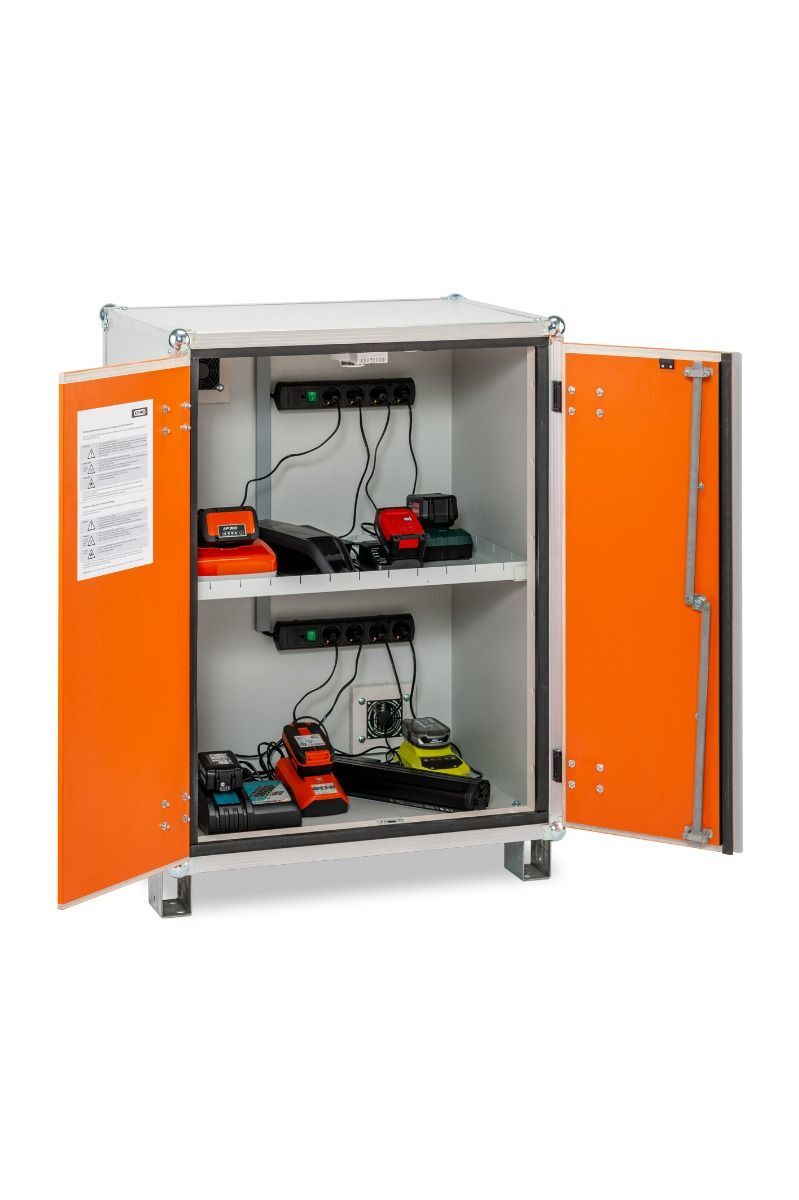 Here you will find the important properties of special battery charging cabinets and the distinction from fireproof cabinets for Li-Ion batteries:
- Always an integrated power supply
- Depending on design with 230V, USB, etc.
- Versatile possible uses
- Fire protection / fire resistance optional only (unlike the safety cabinets for batteries)
- Safety: Batteries can become dangerous if stored improperly or overcharged. A charging cabinet ensures they are charged in a protected environment, minimizing the risk of damage or fire.
- Order: With a battery charging cabinet you can store different batteries systematically and neatly. This facilitates access and handling.
- Efficiency: Instead of using individual chargers for each battery, several batteries can be charged simultaneously in one cabinet. This saves time and reduces cable clutter.
- Longevity of batteries: Consistent and correct charging can extend battery life.
- Mobility: Many battery charging cabinets are mounted on wheels, making transport between rooms easier.
- Size and capacity: Think about how many batteries you want to store and charge at the same time.
- Compatibility: Ensure the cabinet is suitable for the type of batteries you own.
- Safety features: A good charging system should offer overcharge protection and short-circuit protection.
- Ventilation: Good ventilation is important to prevent battery overheating.
- Additional features: Some cabinets offer extra functions such as timers or separate compartments for different battery types.
In summary, a battery charging cabinet is a valuable investment for anyone who regularly works with many batteries. It provides not only an efficient charging solution but also safety and order for your valuable devices.
The key properties of charging cabinets for Li-Ion batteries are, besides storage options, the connection options for chargers.
As the name “battery charging cabinet” suggests, the ability to charge batteries inside the cabinet is a central functionality of these products. Depending on design and individual needs, there are different provisions/connection options that enable charging. Both integrated 230V and increasingly USB ports are available in battery charging cabinets for this purpose.
Typically, charging cabinets are equipped with 230V sockets, where batteries can be charged as if from any household outlet. At these 230V Schuko sockets, usually all battery chargers can be connected. To ensure sufficient power for the entire battery charging cabinet, the power supply can be provided here via a 390-V plug (often also referred to as a high-voltage connection).
In addition to the normal 230V sockets, many charging cabinets are equipped with USB ports that particularly enable charging smartphones, tablets, notebooks, etc. This allows you to do without specialized chargers and simply charge devices via a cable. This not only provides more order in the charging cabinet but also allows a large number of smartphones, tablets, etc. to be charged in parallel. Up to 30 USB ports are provided in the battery cabinets, making them ideal for use in classrooms to reliably charge students’ tablets outside of class time.
Depending on the model, battery charging cabinets have certain safety precautions. Fans, distribution boxes, integrated circuit breakers or a temperature control provide the necessary safety in operation of the battery charging cabinets. Important to note: In case of fire, the battery charging cabinets presented here do not offer explicit fire protection. This is provided by the specially designed safety cabinets for Li-Ion batteries. Accordingly, when using battery charging cabinets you should always have a extinguishing agent ready to quickly combat a potential battery fire. For example, fire extinguishers for Li-Ion batteries are suitable.
To protect the batteries, smartphones, tablets, etc. stored in the charging cabinets from theft or unauthorized access, the various models have different mechanisms. Common are classical locks, but there are also models that can be opened with key codes, smart cards and other mechanisms. Some battery charging cabinets also have multiple individually lockable compartments—ideal for use in different environments such as educational institutions, clubs, etc. For example, the Battery High-Value Cabinet has four separate compartments that, in addition to charging, have lockable doors.
Overall, the field of battery use, storage, and safe charging of Li-Ion batteries is still relatively new and has not yet been comprehensively incorporated into existing laws or regulations. Consequently, there are no fixed regulations for battery charging cabinets that are binding. However, various institutions already provide a number of recommendations and guidelines, which although cannot replace real regulations for charging cabinets, are a helpful aid for everyday use.
Because there are no fixed regulations and standards for charging cabinets yet, manufacturers of facilities have a lot of freedom and can basically declare any cabinet a charging cabinet if it has a charging option for batteries. In particular, there are no requirements for fire protection, i.e., the cabinets do not necessarily have to be fireproof. This is also an important distinguishing feature from the safety cabinets for Li-Ion batteries, which always have certified fire resistance.
Even though there are no fixed regulations or requirements for the charging devices presented here, all cabinets are from reputable manufacturers who have tested the cabinets extensively. The testing primarily relates to operational safety. Through charging options in the form of 230V sockets or USB ports, the normal electrical safety tests must be performed to ensure safe use in daily operation, in schools, or in other facilities.
With the increasing spread of Li-Ion batteries in daily life, both in the professional world and in education, leisure, and household, the usage possibilities of battery charging cabinets are almost endless.
In all professional domains where a large number of mobile electronic devices are used, battery charging cabinets are part of the equipment. Whether for charging handheld scanners in order picking, for charging drivers’ company mobiles, or for Powertool batteries in a craft business, the possible uses are varied. Battery charging cabinets not only ensure organized storage and charging of Li-Ion batteries, but their lockable doors also protect against unauthorized access.
Digitalization is increasingly entering the school sector, so smartphones and tablets are part of school life in many schools and other educational institutions. To ensure devices are ready to use in the morning with a full battery to start lessons, battery charging cabinets are suitable: after school, students connect the tablets here for charging, overnight the Li-Ion batteries recharge, and the next morning energy is ready for classes. In principle, no classroom should be without a battery charging cabinet.
Models with many USB ports are particularly suitable. Depending on the model, up to 30 devices can be charged simultaneously, so practically all students’ tablets can be charged outside class hours and be ready for the next day.
What used to be the job of the human caddy on the golf course – carrying the golf bag – is increasingly taken over by battery-powered golf trolleys / golf caddies. After a long round and 18 holes, the batteries of the golf caddies/electric caddies usually need to be charged again. Battery charging cabinets are suitable here as well. Depending on capacity, a cabinet can charge up to 18 Li-Ion batteries at the same time and be ready for the next round after a short time. This convenience of battery-powered golf trolleys is increasingly offered by golf clubs, so the use of battery charging cabinets in this area is also rising sharply.
In connection with battery cabinets there are two different types: simple battery charging cabinets and safety cabinets for Li-Ion batteries. While the former offer an affordable way to charge a large number of batteries in an organized manner, battery safety cabinets offer a variety of additional features, especially in the area of fire protection to limit the dangers posed by batteries.
As the name suggests, the battery charging cabinets presented in this category are primarily designed for the structured and simultaneous charging of many Li-Ion batteries. With appropriate power connections, multiple levels, viewing windows, etc., they provide all the means to conveniently power a multitude of devices at the same time. In the event of a fault of Li-Ion batteries, such as a battery fire, they offer no special protective mechanism.
If safety in battery storage is paramount, corresponding battery safety cabinets are indispensable. With comprehensive fire protection certification, self-closing doors, ventilation, etc., they offer a safety level for storing intact and defective lithium batteries, which is not reached by the simple charging cabinets presented here. Optional with a power supply, the battery safety cabinets can also provide the charging function, i.e., for both fireproof battery storage and simultaneous charging.


